
Speaking French means being able to communicate with a vast section of the modern world
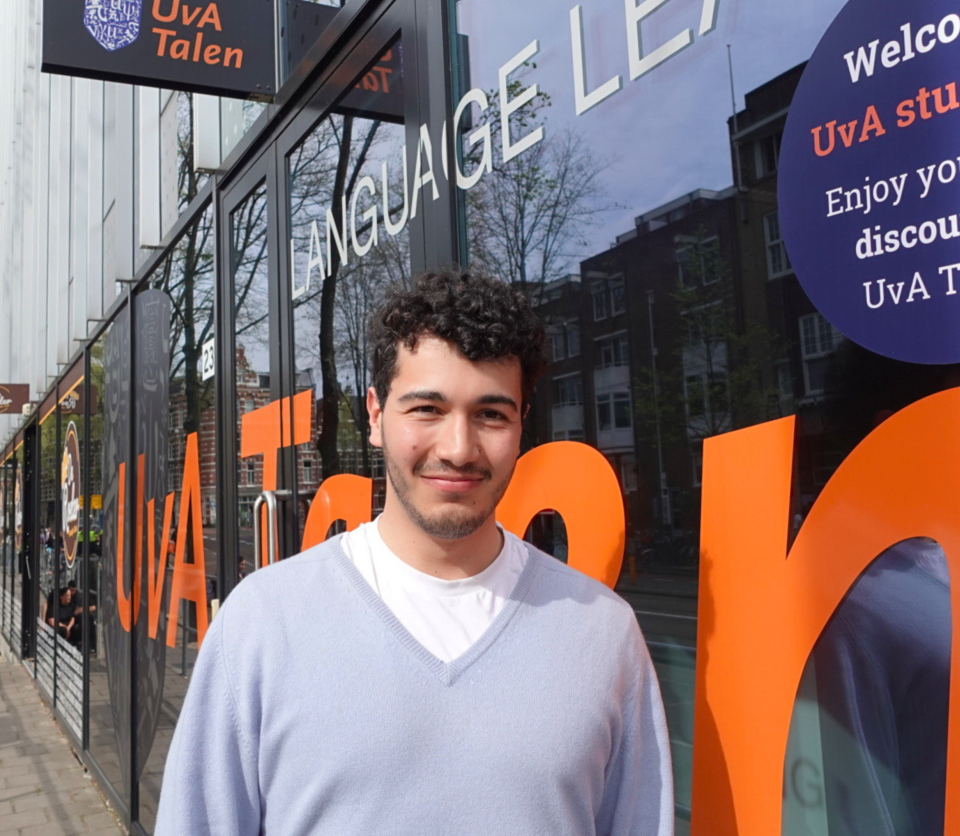
A conversation with Filippo, a group and tailor-made course student learning French at UvA Talen.
Can you tell us something about yourself?
Hi, my name is Filippo and I am originally from Rome, Italy. I’m currently in my 3rd and final year of Economics and Business Economics at the University of Amsterdam, specialising in finance and for the past couple of years, I’ve been learning French.
Why do you want to learn French?
On the surface, it’s an extremely useful language to know (both in my field and in general) with hundreds of millions of native speakers spread over twenty-five different countries and five continents. Speaking French means being able to communicate without barriers with a vast section of the modern world, both for business and leisure. As a European who plans to live and work in Europe, I am also well aware of the role this language plays in politics and economics of the continent. And on a more personal level, I find French and Italian to be very close to each other in terms of language, culture and society.
Learning a second (or in this case, third) language is a big and often challenging step, and staying in somewhat familiar territory made the experience much more pleasant. Learning this sister language has brought me joy, satisfaction, and many new perspectives and insights. From cuisine and literature, to new ways of thinking about work-life balance and how citizens should interact with their government. From architecture museums in Montréal and sustainable agricultural techniques in the Maghreb, to traditional Polynesian customs and some interesting marriage traditions of rural Auvergne. I recognise this might not be everyone’s cup of tea, but as someone who deeply enjoys learning and discovering new things about the world, French was a perfect fit.
Last but not least, I also find the language very expressive and beautiful to hear
What course have you taken with UvA Talen and how was your experience?
In April 2023, I took group courses going from French level 4 (around the A2 level) to level 7. I also took tailor-made lessons to reach level 8 (B2) this January. Overall, I’m very happy with my experience!
The best thing UvA Talen courses have going for them is how complete they are. Love it or hate it, learning a language is more than conversations. This is especially true for French with its complex verb tenses and myriads of rules and exceptions. The courses gave me strong grammatical foundations to build upon, with detailed explanations of complex topics.
My biggest weakness when learning a new language is usually the listening, and French sounds can be notoriously different to tell apart for the untrained ear. I feel the courses’ approach really helped me in this regard as well. I also found the vocabulary lists provided at the end of each lecture very useful, with new words and expressions organised by subject to make memorisation easier.
Overall, though, the thing I find most important in a language course is that it provides learning with structure. It is a lot harder to maintain structure when self-studying. The lessons at UvA Talen were very well structured, following along and expanding on book chapters, covering both interesting topics (culture, current affairs, etc.) and accompanying grammar. I also really liked the online resources provided, with well-organised vocabulary lists and grammar slides. Courses here are a bit pricier than the alternatives, but in my opinion, the quality justifies this difference. The teachers were also super nice. I worked with two different ones, and while their approaches were quite different, I found both their methods very enjoyable to follow. My fellow students in the group courses were all very nice too, and the classroom environment overall was very pleasant. The individual lessons were obviously more focused and tailor-made to fit my learning needs, but also significantly more expensive.
How do you combine being a full-time student and language courses? What should all potential students know to help keep this balance?
I think the main driver for me was seeing the progress I was making. After each lesson, I’d reflect on all the new words and expressions I had learned compared to the week before, which made me proud and happy. During particularly stressful periods, it often became one of the highlights of my week, at least academically. It’s much easier to stay motivated when you notice real progress. Having a routine also helped keep things manageable, with two and a half hours of lessons on Thursdays, plus a couple of hours on Sundays for homework and individual study. Again, the structure delivered results.
What’s your favourite word or expression you’ve learned in French?
“Les doigts dans le nez”. Very silly one, it means that something is very easy but it’s literally translated as “fingers in the nose”.
“En faire tout un fromage”. Means making a big fuss about something, literally “making a whole cheese out of it”.
“Filer à l’anglaise”. An Irish exit is apparently an English exit in French…
What is your end-goal with learning French?
I still don’t know what the future holds, but I hope to speak French often. Next year, I’m starting my two-year master’s program in Milan, and I’d love to spend the second year in Paris as an exchange student. In the future, I might decide to work in Paris, given that it's one of the biggest financial hubs in Europe. For now, I’m happy visiting France and being able to fully immerse myself in the culture. Being a tourist is nice, but being able to communicate with the locals adds a whole new layer to the experience.
Want to learn French like Filippo?